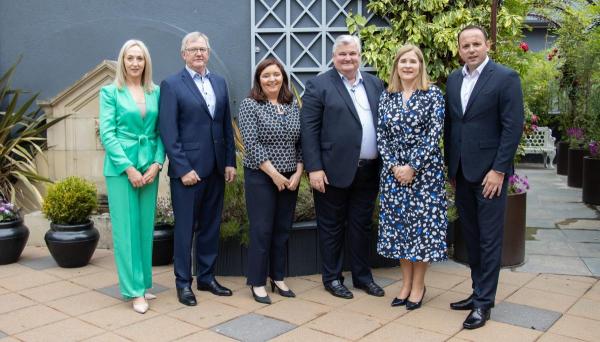
Pictured at the launch of
Horwath Bastow Charleton's Hotel Industry Survey 2006 were (l-r):
Deirdre Moran, Hospitality Consultant, Horwath Bastow Charleton;
Justin Baily, Partner, Horwath Bastow Charleton; Mr. John O'Donoghue,
TD, Minister for Arts, Sport and Tourism; Joe McWilliams, Director,
Anglo Irish Bank and Aiden Murphy, Partner, Horwath Bastow Charleton.
Horwath Bastow Charleton's Annual
Hotel Survey for Ireland and Northern Ireland has revealed increasing
payroll costs that could threaten the future profitability of
Irish hotels. The survey, which was launched by Minister for
Arts, Sports and Tourism, John O'Donoghue, TD, shows a significant
increase in hotel payroll costs throughout the country in 2005
with labour costs now accounting for 37.6% of total revenue compared
to 35.4% in 2004.
At the launch of the report,
Aiden Murphy, Partner, Horwath Bastow Charleton, said, "As
the single biggest cost for hoteliers, we predict that payroll
expenditure could undermine the future profitability of the hotel
industry. In a buoyant year of strong sales, enhanced profitability
has been lost due to the continuing increase of payroll costs.
If the surge in new supply to July 2008 impacts revenue performance
of hotels, then the higher payroll costs we have seen this year
could further threaten the prospect of maintaining hotel profits
at present levels. Hoteliers will need to address the issue of
trimming payroll costs in the wider context of National Pay Agreements,
in order for the industry to continue to develop."
John Power, Chief Executive,
IHF, noted that the standards in Irish Hotels are as good as
anywhere in Europe and that ongoing regulation of the hotel sector
has ensured that high standards are maintained. Mr Power identified
labour costs as a serious concern for hotels and noted that over
40% of revenue at smaller hotels could be spent on labour alone.
Several key findings of the survey
include:
- 43% of all visitors to Dublin
hotels visit for business/meeting purposes - the highest level
in the Republic of Ireland
- 60% of all visitors to Dublin
hotels are from the overseas market
- Approximately 1,000 new hotel
rooms have been added to the Dublin market in 2005
- Average profit of Dublin hotels
is 200% of that achieved in Western Seaboard
- Occupancy rates in Dublin continue
to climb with an increase of 2.2% on 2004
- Overall room rates in all regions
have increased by approximately 3%
- Average occupancy rates in all
regions have increased by 2.8%
While the majority of results
were positive for the industry as a whole, the report indicated
that the Western Seaboard is still failing to perform at the
same level as counterparts throughout the country with seasonality
having a major impact on the profitability of hotels in these
regions. While occupancy rates have not decreased in 2005, the
Western Seaboard's average room rates for hotels were 16.3% less
than for hotels overall, resulting in profits being the lowest
in the country.
Mr Murphy added, "Hotels
in the Western Seaboard are suffering due to access problems
and the lack of investment in regional airports. It is vital
that this imbalance be addressed in order for this market to
thrive. The combined factors of Dublin airport being the major
gateway for visitors and shorter average length of stays by overseas
visitors leaves the Western Seaboard at a marked disadvantage
in terms of capturing their fair share of overseas tourists."
The Horwath Bastow Charleton
Ireland and Northern Ireland Hotel Industry Survey is carried
out on an annual basis. Hotels throughout the island of Ireland
are surveyed on a number of topics including room occupancy average,
average daily room rate, revenue per room and profit before tax
per available room.
|