

Joint Oireachtas Committee on Enterprise, Tourism & Employment
Update: 25th November 2026
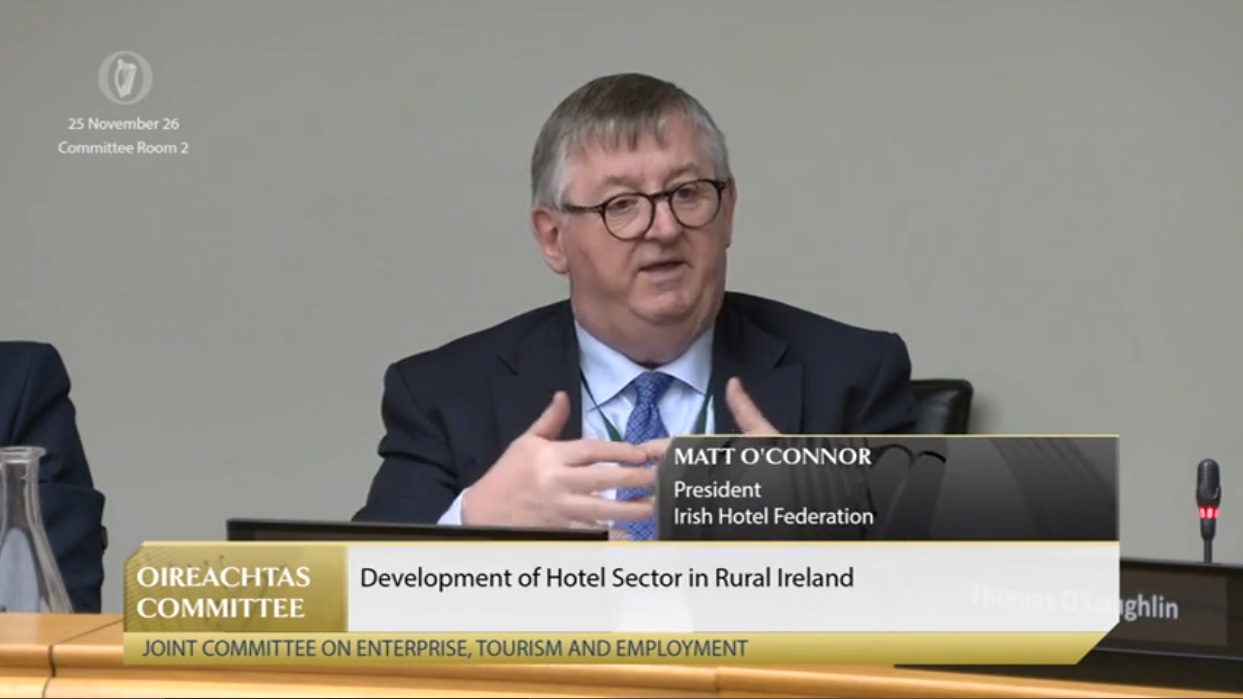
The Irish Hotels Federation recently appeared before the Joint Oireachtas Committee on Enterprise, Tourism & Employment to discuss issues related to regional hotel development.
IHF President Matt O’Connor and Chief Executive Paul Gallagher took the opportunity to outline the targeted policy measures needed to unlock private investment and expand capacity across regional Ireland. We called for a coordinated five-year Government framework featuring an ISIF-backed development fund, accelerated capital allowances, vacant building conversion grants, and capital gains rollover relief to support both new developments and extensions to existing hotels.
Video: a video recording of meeting is available HERE.
Introductory remarks: a trancipt of our opening statement is available below.
Opening Statement, Irish Hotels Federation
Joint Oireachtas Committee on Enterprise, Tourism and Employment
25th November 2026
Cathaoirleach and members of the Committee, on behalf of the Irish Hotels Federation, I would like to thank you for the opportunity to address you today on the issue of tourism accommodation capacity and the policy measures required to support the future growth of Irish tourism.
The Government has set ambitious targets for the growth of Irish tourism, which we fully support. However, these ambitions cannot be realised without the necessary accommodation infrastructure. Failure to address capacity constraints will undermine our international competitiveness and result in lost economic opportunities, particularly in regional Ireland.
The scale of the challenge
Current industry estimates indicate that Ireland requires an additional 10,000 to 15,000 hotel bedrooms by 2031, after taking account of committed developments, returning accommodation stock and anticipated market exits.
Between 1990 and 2010, Ireland increased its hotel accommodation stock from approximately 22,000 to 60,000 bedrooms, an average increase of 1,900 bedrooms per annum. Since 2010, that rate of growth has fallen to approximately 500 bedrooms per annum.
Of particular concern is the significant divergence between Dublin and regional Ireland. Research undertaken by Crowe on behalf of the Federation shows that, between 2010 and 2026, Dublin increased its hotel bedroom stock by almost 7,900 rooms, while regional Ireland experienced a net loss of 213 bedrooms.
In effect, regional Ireland has fewer hotel bedrooms today than it had 16 years ago. This is fundamentally at odds with Government policy to achieve a greater regional spread of tourism and balanced economic development.
The principal barrier to development is commercial viability. Increased construction costs, higher financing costs and wider business cost pressures have resulted in projects being deferred. Research indicates that new hotel developments can face a viability gap of up to 20%.
Furthermore, the increased regulation of short-term lettings is likely to see some existing tourism accommodation return to residential use. While we recognise the importance of addressing the housing crisis, there must be a parallel strategy to increase dedicated tourism accommodation.
Policy measures to stimulate investment
The Federation has commissioned Crowe to identify practical policy interventions that Government could consider to stimulate investment across all forms of registered tourism accommodation. Four principal areas have been identified:
Improving access to development finance
We propose the establishment of a dedicated Tourism Accommodation Development Fund, backed by the Ireland Strategic Investment Fund (ISIF), providing competitively priced finance, equity co-investment and guarantee facilities for commercially sound projects facing demonstrable funding gaps.
There are precedents for such interventions in the housing sector. A similar approach could be adopted for tourism accommodation, including partnerships with local authorities to provide serviced, development-ready sites. State investment could be recovered over time and recycled into subsequent projects.
Targeted tax incentives
Ireland has previously demonstrated the effectiveness of capital allowances in stimulating hotel development. However, any new scheme must be operator-led, commercially sustainable and aligned with identified market demand.
We propose that Government examine accelerated capital allowances, allowing qualifying investment expenditure to be written off over two years, or alternatively, a targeted investment tax credit of up to 20%.
These measures would improve cash flow during the critical development phase, supporting investment in additional capacity, modernisation, accessibility and energy efficiency.
Bringing vacant and underutilised buildings back into use
With approximately 30,600 vacant commercial units across Ireland in 2025, there is an opportunity to identify suitable properties for conversion into tourism accommodation.
Targeted conversion grants, accelerated capital allowances, streamlined planning processes and local authority-led regeneration initiatives could unlock additional capacity while contributing to the revitalisation of our towns and cities.
Attracting private investment into tourism
A targeted capital gains tax rollover relief could encourage investors to reinvest the proceeds from the disposal of existing assets into qualifying tourism accommodation businesses.
Subject to a minimum five-year investment period and appropriate safeguards, this could provide access to long-term equity capital, supporting accommodation expansion and attracting greater levels of private investment into the sector.
Unlocking capacity within existing hotels
One of the most immediate opportunities lies within our existing hotel stock. If 200 existing hotels were supported in adding just 20 bedrooms each, this would deliver an additional 4,000 bedrooms nationally.
These businesses already have established management teams, employees, customer bases and operational infrastructure. Extensions can generally be delivered more quickly and with less commercial risk than entirely new developments.
This approach would be particularly beneficial to independently owned regional hotels, allowing them to achieve greater economies of scale, improve competitiveness and strengthen their long-term viability.
A coordinated Government response
The Federation believes that a five-year national tourism accommodation capacity framework is now required, identifying where additional capacity is needed and the policy interventions necessary to deliver it.
This will require a coordinated approach across Government departments, Fáilte Ireland, ISIF and local authorities.
Investment in tourism accommodation must be viewed as investment in long-term economic infrastructure. Hotels generate employment, support local suppliers and contribute significant revenues to the Exchequer and local authorities over many decades.
We are not seeking open-ended subsidies. We are seeking targeted, time-limited and commercially focused interventions that address demonstrable viability gaps and unlock private sector investment.
Given the lead-in times associated with planning, financing and construction, decisions need to be taken now if Ireland is to meet its accommodation requirements by 2031.
We would ask the Committee to support the development of a coordinated Government response and recommend that the four policy measures outlined today be progressed for detailed examination.
The Irish Hotels Federation stands ready to work with Government and its agencies to deliver on this ambition.
Thank you, and we look forward to discussing these proposals with members of the Committee.
Irish Hotels Federation
Irish Hotels Federation | Working Together