



For more than two decades, hotel digital marketing has largely revolved around one objective: ranking highly on search engines.
Today, however, the way travellers discover hotels is changing.
Increasingly, guests are turning to AI-powered tools such as ChatGPT, Google AI Overviews, Gemini and other conversational search platforms to research destinations, compare accommodation options and seek personalised recommendations. Instead of browsing through pages of search results, travellers can now ask:
"What are the best luxury spa hotels in Ireland?"
"Where should I stay in Kerry for a romantic anniversary break?"
"Which Irish hotels offer Michelin-star dining and coastal views?"
In response, AI platforms generate curated recommendations based on information gathered from across the web.
For hoteliers, this shift presents both an opportunity and a challenge. Visibility in traditional search engines remains important, but increasingly, hotels must also consider how AI platforms discover, interpret and recommend their properties.
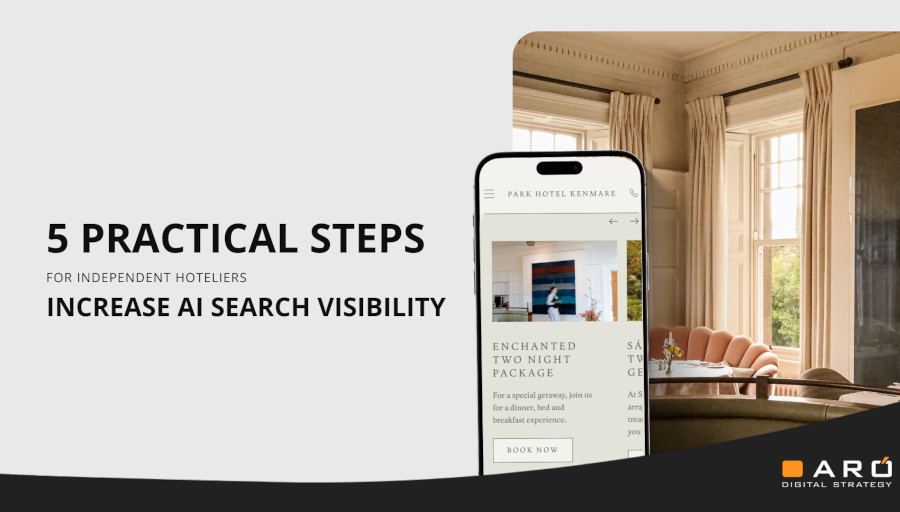
The Rise of AI-Assisted Travel Planning
AI-powered search is rapidly changing consumer behaviour.
Travellers are no longer searching solely with short keywords. Instead, they are asking detailed questions and expecting tailored recommendations. This represents a significant shift from traditional search behaviour and places greater emphasis on expertise, authority, trust and content quality.
Unlike conventional search engines that primarily return a list of links, AI platforms seek to identify the most relevant and credible recommendations based on a wide range of signals.
For luxury independent hotels, appearing in these recommendations could become as important as appearing on the first page of Google.
What Makes a Hotel Visible to AI?
While AI recommendation systems continue to evolve, several common factors influence which hotels are surfaced in responses.
1. Build Destination and Experience Authority
AI systems favour websites that demonstrate genuine expertise.
Hotels should think beyond room descriptions and focus on creating valuable content around their destination, local attractions, dining experiences, wellness offerings, activities and seasonal events.
A hotel that provides comprehensive information about its location and guest experiences is far more likely to be recognised as an authority than one that focuses exclusively on accommodation.
For example, a luxury property in Kerry should not only showcase its guestrooms and facilities but also provide meaningful content about the Ring of Kerry, outdoor adventures, local culture and unique regional experiences.
The more helpful your content is to prospective travellers, the more valuable it becomes to AI systems.
2. Strengthen Reputation and Review Signals
Guest reviews have become one of the most influential trust indicators online.
AI platforms frequently draw insights from reviews, ratings and guest feedback when evaluating recommendations. Hotels with consistently strong reputations across multiple trusted platforms are more likely to be viewed as reliable recommendations.
This makes reputation management more important than ever.
Hotels should actively encourage guest reviews, engage with feedback and maintain strong profiles across Google, Tripadvisor, online travel agencies and other relevant platforms.
Trust is one of the fundamental pillars of AI visibility.
3. Optimise Website Structure and Content
Even the most beautiful website can struggle to perform if its content is difficult for search engines and AI systems to understand.
Clear website architecture, descriptive content, detailed property information, FAQs and structured data all help AI platforms interpret what makes a hotel unique.
Information should be easy to find, easy to understand and consistently maintained across all digital touchpoints.
Hotels that invest in well-organised, information-rich websites will be better positioned for both traditional and AI-driven search visibility.
4. Increase Brand Mentions Across Trusted Sources
AI recommendations are influenced not only by what a hotel says about itself but also by what others say about it.
Mentions in respected travel publications, tourism websites, award programmes, destination guides and industry directories all contribute to a hotel's digital authority.
When AI systems consistently encounter positive references to a hotel across multiple trusted sources, confidence in recommending that property increases.
This highlights the growing importance of public relations, partnerships, awards and content marketing as part of a hotel's overall digital strategy.
5. Create Content That Answers Real Traveller Questions
AI search is fundamentally question-driven.
Hotels should identify the questions travellers are asking and create content that provides the answers.
Examples include:
- Best luxury hotels in Ireland for wellness breaks
- Romantic hotel escapes in Kerry
- Family-friendly luxury hotels on the Wild Atlantic Way
- Michelin-star dining experiences in Ireland
- Luxury golf and spa breaks
By addressing genuine traveller queries, hotels increase the likelihood that AI systems will recognise their content as relevant and authoritative.
A Practical Example
Consider the following AI search query:
in Ireland with exceptional dining experiences?"
AI systems are likely to favour hotels that:
- Clearly communicate their dining credentials
- Demonstrate strong guest satisfaction
- Have authoritative website content
- Appear in trusted travel publications
- Have consistent brand mentions across the web
- Provide detailed information about their guest experience
What This Means for Independent Hotels
The hospitality industry has always adapted to changing consumer behaviour.
From the rise of online travel agencies to mobile booking and social media marketing, each shift has created new opportunities for hotels willing to evolve.
AI-powered search represents the next major transformation.
While traditional SEO remains important, hotels should begin considering how their content, reputation and digital presence influence AI-generated recommendations.
The good news is that many of the principles that support AI visibility are already aligned with best-practice hotel marketing: creating valuable content, delivering exceptional guest experiences, earning positive reviews and building a trusted brand.
The difference is that these signals are becoming increasingly important in determining whether AI platforms recommend your hotel to prospective guests.
Summary
The future of hotel discovery is likely to involve a combination of traditional search, AI-assisted recommendations and direct brand engagement.
For independent and luxury hotels, this presents an opportunity to compete on quality, expertise and guest experience rather than simply advertising spend.
The hotels that invest today in authoritative content, strong digital foundations and reputation management will be best positioned to thrive in this new environment.
As AI continues to reshape the way travellers research and book accommodation, visibility will increasingly belong to the hotels that are not only easy to find, but worthy of being recommended.
Contact details

Alan Rowe Managing Director 086 803 2173 / 091 597 200 alan.rowe@aro.ieWeb www.arodigitalstrategy.com
 ©2026 Irish Hotels Federation
 13 Northbrook Road, Dublin 6, D06 PK18, Ireland Tel: 01 497 6459 | E-mail: info@ihf.ie