



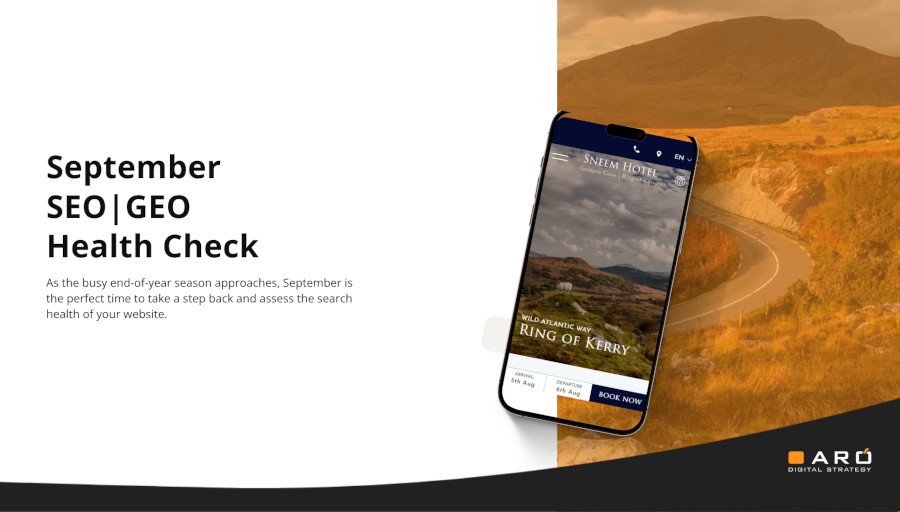
This is an important point in the hotel marketing calendar. Autumn and winter demand is taking shape, Christmas and gift voucher campaigns are approaching, and many hotels are already planning their strategy and budgets for the year ahead. It is also a good time to take stock of your hotel’s digital performance.
Travellers are discovering and researching hotels across Google Search and Maps, OTAs, social media and, increasingly, AI-powered search and recommendation platforms. This evolution means hotels need to think not only about where they rank, but whether their digital presence gives search engines and AI platforms the information they need to understand, trust and recommend their property.
This is where Generative Engine Optimisation (GEO) is becoming increasingly important alongside traditional SEO.
BEFORE Q4, HERE ARE 7 AREAS WORTH REVIEWING:
1. Understand How Guests Are Finding You
Start with your own data. Google Search Console and GA4 can provide valuable insight into how guests are discovering and interacting with your website.
Look at:
- The searches generating impressions and clicks
- Your strongest organic landing pages
- Pages gaining or losing visibility
- Branded versus non-branded search performance
- Key geographic markets and devices
- Organic visitors progressing into the booking journey
- Bookings and revenue attributable to organic traffic
Search behaviour is changing and a fall in website traffic or sessions doesn’t necessarily mean poorer commercial performance. A smaller number of better-qualified visitors who progress into the booking engine and convert can be considerably more valuable than higher volumes of low-intent traffic.
The objective is more of the right traffic, rather than volume alone.
2. Check Whether You’re Visible for What Guests Actually Want
One of the most useful exercises a hotel can undertake is to look at its website from the guest’s perspective.
A potential guest may search for:
family hotel near Killarney
romantic hotel break Ireland
hotel with sea swimming or a swimming pool
country house wedding venue
luxury spa hotel Cork
These more specific searches can reveal much stronger intent than a broad term such as “luxury hotel”.
Review the searches associated with your priority guest segments and ask whether your website genuinely reflects the experiences, facilities, location and attributes they’re looking for.
Your content strategy should be built around why guests choose your hotel.
3. Make Sure AI Can Understand Your Hotel
SEO remains fundamental and with search is evolving quickly, travellers are increasingly asking AI-powered platforms detailed questions such as:
“Where should we stay in Ireland for a luxury weekend with excellent food and sea views?”
“Which hotels in Waterford have a spa and are good for a romantic break?”
“Recommend a family-friendly hotel in Kerry with activities nearby if it rains.”
These are very different from the short keyword searches hotel SEO traditionally focused on.
For your property to have a chance of appearing in these recommendations, AI systems need to be able to understand clearly what your hotel is, where it is, what it offers and why it is relevant.
Review whether your website provides clear, factual information about your location, accommodation, dining, spa and wellness facilities, weddings and events, family facilities, experiences, accessibility, awards and other recognised credentials.
FAQs can also be particularly useful for answering the practical questions potential guests have.
Beautiful photography and evocative brand language remain essential to selling a hotel experience, and they need to be supported by clear, structured information that both search engines and AI platforms can easily interpret.
4. Strengthen Your Hotel’s Digital Footprint Beyond Your Website
In the age of AI search, what the wider web says about your hotel increasingly matters alongside what you say about yourself.
Your own website is your core source of information about your hotel. In addition, search engines and AI platforms encounter information about properties across Google Business Profile, OTAs, review sites, social channels, tourism organisations, directories and destination websites.
Make sure your Google Business Profile is accurate and up to date, including amenities, imagery, contact details and other relevant property information.
Check that important information such as your hotel name, address, location, facilities and positioning is accurate and consistent across other important third-party sources too.
Think about authority. Awards, credible media coverage, tourism listings, industry memberships and links from respected third-party websites can all contribute to a stronger digital footprint.
Where appropriate, structured data on your website can provide additional context to search engines about your hotel and its content.
5. Give Your Highest-Value Pages a Q4 Refresh
September is a particularly useful time to review the pages expected to work hardest over the coming months.
Depending on your hotel’s markets, these might include:
- Autumn and winter breaks
- October mid-term
- Christmas stays and dining
- Festive events
- Gift vouchers
- New Year’s Eve
- Winter spa breaks
- January escapes
- Weddings and events
- Early 2027 offers
Ask whether these pages provide enough useful information to deserve visibility in increasingly competitive search results.
Does the page clearly explain the experience? Does it answer likely guest questions? Are dates and inclusions clear? Is there a compelling reason to choose your hotel? Is the route to booking obvious?
Avoid creating a brand-new URL each year if you already have a strong seasonal page. Updating an established Christmas, mid-term or seasonal landing page allows you to retain the authority, links and search history that URL has already built.
6. Check the Journey From Search to Booking
Getting discovered is only half the job. Your SEO and GEO health check should follow the potential guest all the way from a search result through your website and into your booking engine.
Website speed is particularly important for hotels. High-resolution photography and video are powerful selling tools, but oversized files, scripts and third-party integrations can also slow the experience considerably.
Test your key journeys on mobile as a guest would.
Can someone move easily from:
Search → landing page → offer → availability → room selection → booking?
Review page speed, mobile usability, room descriptions, imagery, rates, offer consistency, availability messaging and the transition between your website and booking engine.
Also make sure your analytics follow the journey correctly. Cross-domain and ecommerce tracking should allow you to understand which marketing activity is actually generating bookings and revenue.
A number-one ranking has limited commercial value if the subsequent booking journey loses the guest.
7. Create Content That Only Your Hotel Could Produce
With generative AI making generic content extremely easy to create, originality and genuine expertise are becoming more valuable.
Independent hotels have a significant advantage here: your team knows your property and destination better than almost anyone else.
Instead of producing another generic “10 Things to Do” article, ask your concierge to recommend their favourite morning walk.
Let your chef introduce the local producers behind the menu.
Create genuinely useful guides to nearby beaches, cycling routes, family attractions or local shops.
Speak to your reservations team about the questions guests repeatedly ask before booking and answer them properly on your website.
This type of content provides something generic AI-generated copy cannot easily replicate: first-hand knowledge and genuine local expertise.
It can also help demonstrate to both travellers and search platforms what makes your hotel distinctive and worth visiting.
LOOK BEYOND RANKINGS
Keyword positions remain useful; however, rankings do not provide a complete picture of hotel search performance.
Consider monitoring a broader range of indicators, including organic search visibility, non-branded search performance, Google Business Profile visibility, organic booking engine entries, conversion rate, direct bookings and revenue, referral traffic and visibility for the topics and experiences that are most important to your hotel.
Hotels should also begin observing how consistently their property appears when relevant questions are asked across AI-powered search and recommendation platforms.
The key question is no longer, “Where do we rank?” The question worth answering is: “Can the right guest discover us, understand why we’re relevant, trust us, and easily book us directly?”
TIME FOR A DIGITAL RESET
Q4 represents an important commercial period for many Irish hotels. Taking the time now to review these 7 areas can help identify weaknesses, strengthen priority content and ensure your digital foundations are ready for the months ahead.
Aró Digital Strategy works with independent and luxury hotels in Ireland, the UK and internationally, combining hotel website design, booking technology and digital marketing strategies to drive sustainable direct revenue growth.
Contact details

Alan Rowe Managing Director 086 803 2173 / 091 597 200 alan.rowe@aro.ieWeb www.arodigitalstrategy.com
 ©2026 Irish Hotels Federation
 13 Northbrook Road, Dublin 6, D06 PK18, Ireland Tel: 01 497 6459 | E-mail: info@ihf.ie